

Perhaps one of the most overlooked aspects of improving maximal strength or the ability to move significant loads is optimal breathing technique. It may seem insignificant compared to other technical lifting nuances, however, it is the foundation that underpins all proper and safe movement patterns involving heavy loads. Most of us are never taught how to breathe or brace properly when lifting which is likely attributable to the fact that we’ve all been able to unconsciously breathe since birth and assume the same process applies to lifting. We must retrain ourselves to breathe differently when lifting heavy loads, and fortunately, it is a relatively simple process that can be quickly integrated to improve performance.
Common Error
The origin of improper breathing mechanics for heavy loads stems from what most of us are taught at the beginning of our physical activity journey. Take the squat for example, perhaps we learn this movement as a child or newbie gym-goer with nothing more than our own body weight (hopefully this is the case) and we are instructed to “breath in on the way down” and “breathe out on the way up”. Most people might scratch their head and wonder, “yeah, how else are you supposed to do it?”, which is a fair question. This method isn’t necessarily incorrect when we are only moving our body weight or light loads that are not dangerous to us, but what about when we want to lift something significantly heavier for ~1-5 repetitions? What happens then?
Let’s start with the first issue, chest breathing. Most of us take a big deep “shallow breath” (I know it sounds like an oxymoron but stay with me) and fill our chest with air when we think of “breathing in”. Ask yourself, what function does this provide? Quite frankly, not much.
The second issue comes right after which is the exhale or “breath out” portion. This is not advisable when using heavier loads which will be further explained in a minute. The primary point that is important to note about this technique of breathing is that it doesn’t serve any real function regarding heavy resistance training, it simply brings air in and pushes it back out. This might be ok for aerobic exercise, and while still necessary so you don’t pass out, not the primary emphasis of breath control during anaerobic movements aka resistance training.
The Right Way
You're probably wondering now, "how the heck am I supposed to be breathing anyway if I've been doing it wrong this whole time?". Great question… deep diaphragmatic breathing! Before I give you all the details, here’s a quick image of what I’m talking about:
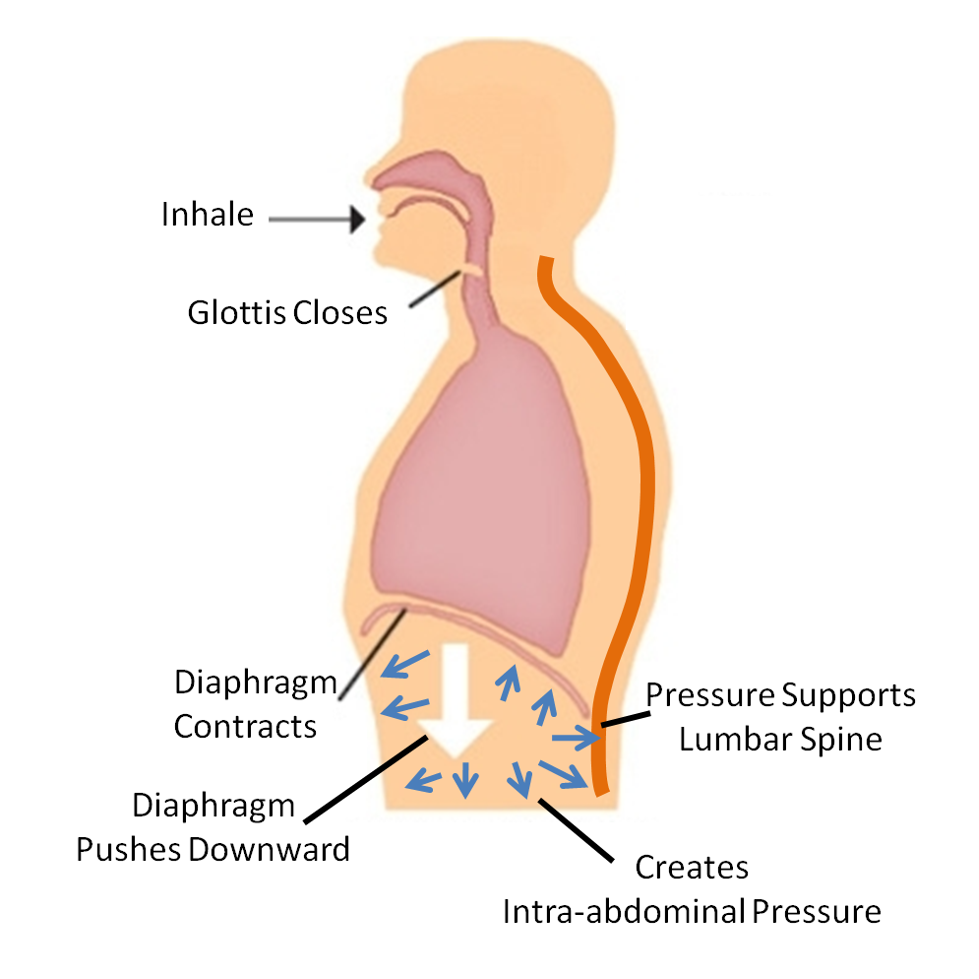
As you can see when we breathe diaphragmatically or “deep into our abdomen area” we create internal pressure. When we combine this internal pressure with proper bracing of our core muscles, we essentially create our own “brace” if you will, or barrier around our spine to keep things stable. This is an important distinction from simply attempting to brace our core muscles alone. We are instead actively filling the diaphragm, and bracing everything properly, to create the desired stability. Now just imagine if you were to exhale or let all that air out on the concentric portion of your squat. That would be quite disastrous likely causing you to fold or fail on the lift.
This technique does have a name; it’s called the “Valsalva” maneuver. You can try this for yourself, and I highly encourage you to do so if you intend on lifting anything heavy. Start by breathing deep into your abdomen such that your belly begins to slightly protrude out. Ideally, you’d like to avoid any movement or rise in your chest while doing this. Next, once you've filled your abdomen with air, contract your core muscles tight and hold them in place which includes essentially everything from your rib cage down to your glutes. Now you are ready to descend on your squat and return to the top while maintaining this internal pressure throughout the entire movement. This does require you to "hold your breath", which can cause an increase in blood pressure and if held for too long, cause lightheadedness, so be careful and reset your breath between each rep to ensure you don't pass out! Also, consult with your health care provider if you are at risk for any issues which may be of concern with this type of breathing or your blood pressure in general just to be safe.
Summary
Proper breathing technique is perhaps one of the simplest yet overlooked aspects of training we can all control. It is something that can be actioned immediately and makes a huge difference in our overall level of performance and safety. It doesn’t take long to learn, and once implemented correctly, will become the preferential method with which to perform all moderate to heavy resistance training movements. Don’t just take my word for it, try it for yourself and note the differences in how you feel and perform. Good luck.